
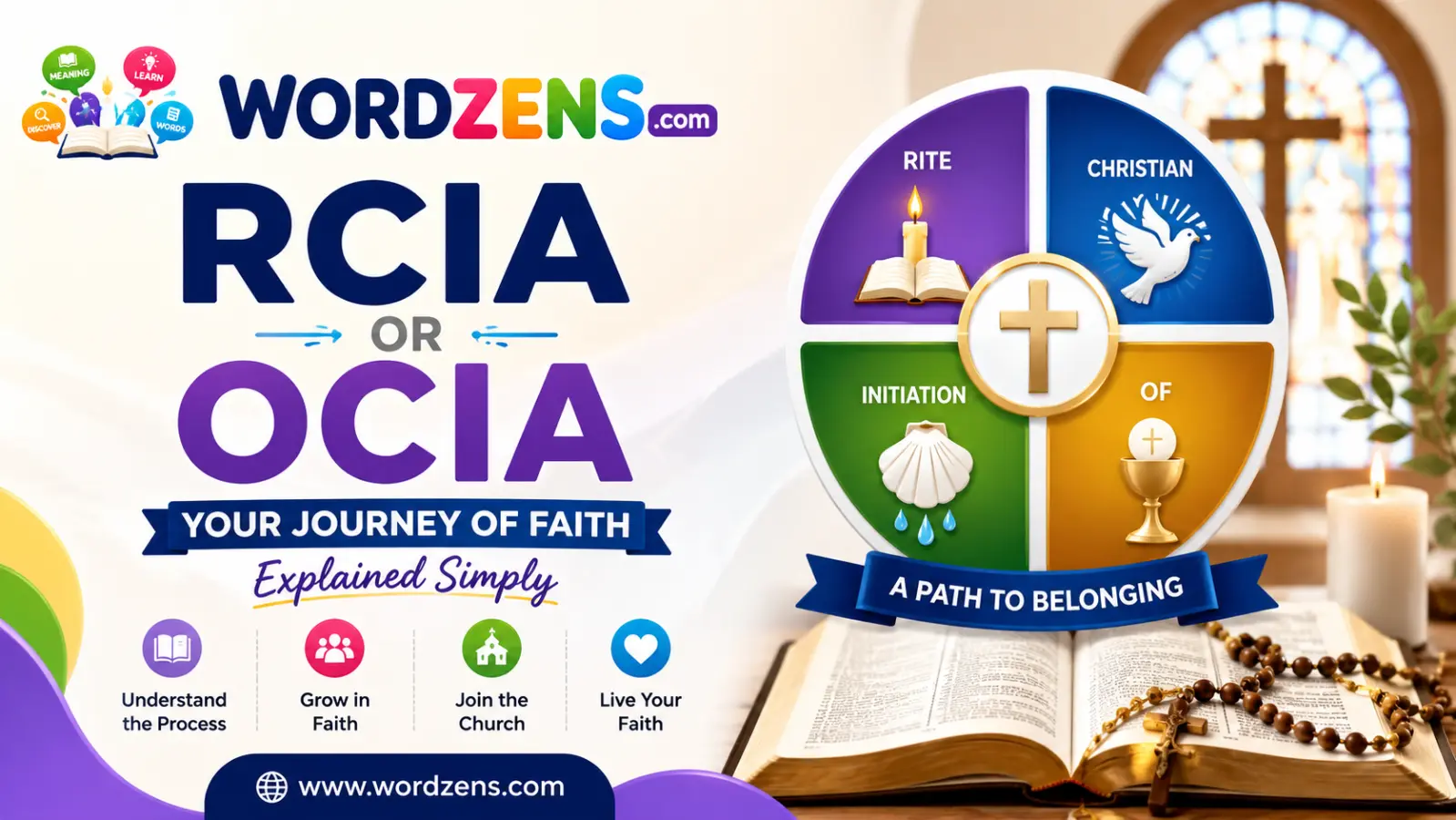
If you have ever come across the terms RCIA or OCIA, you might be asking yourself if these are two different things or if one somehow replaced the other.
If you know anything about them, you are aware that both terms are somehow related to the Catholic church and dealing with people who are interested in converting to it. If you are unfamiliar with the terms, you are in the right place to learn more about what they stand for and how RCIA vs. OCIA are different.
When starting your research on RCIA vs. OCIA, you are likely to stumble upon a number of articles and web pages that fail to explain the difference clearly to you.
If you have been hearing the term RCIA your whole life and you suddenly come across another term, OCIA, it might be hard to understand what exactly is different about the two. Why did one term change into the other and what does it have to do with becoming Catholic?
You will get all of your questions answered here, as we have prepared this brief informative guide to help you learn the difference between OCIA and RCIA.
What Is RCIA?
RCIA is short for Rite of Christian Initiation of Adults. For decades, this was simply “the program” the one you signed up for if you wanted to become Catholic as an adult. Baptism might never have taken place at all.
Baptism could have grown up attending a Christian church down the street.. Baptism could have been Catholic, as a baby yet family never completed confirmation. Life happens.
The process itself wasn’t complicated, but it did take time you weren’t rushing through this in a weekend. You’d start with an inquiry stage, basically a low-pressure “let’s see if this fits” period. Then came actual instruction, often stretching across several months, sometimes closer to a year.
Lent brought a more intense stretch of reflection and preparation. And everything wrapped up at the Easter Vigil, that long candlelit service where people were baptized, confirmed, and received their first Communion, often all in the same night.
You’d hear it tossed around casually, something like:
She’s going through RCIA this year. Our parish’s RCIA classes meet on Tuesday nights, I think. He became Catholic through RCIA back in 2015 or so.
This was basically the standard term across pretty much every English-speaking parish for a long, long stretch the US, Canada, the UK, Australia, you name it going back to right after the Second Vatican Council, when the whole rite got translated into English for the very first time.
And honestly?It’s not something that just came recently; there’s some history to it. The practice originated long ago in the early Church, even if it now often gets abbreviated to an acronym. That’s probably why many longtime Catholics don’t think about it as a process–because that’s how long it’s been around, they just think of it as normal Sunday Mass.
What Is OCIA?
OCIA stands for Order of Christian Initiation of Adults. Here’s the thing, though it isn’t actually a new program. Not even close. It’s the exact same journey people have always gone through, just wearing a new name tag.
Back in November 2021, the US Conference of Catholic Bishops signed off on an updated translation, and parishes started phasing it in gradually over the next couple of years. Some jumped on it right away. Others, well, they’re still catching up.
What’s kind of funny, if you think about it, is that nothing about the actual sacraments changed. Not one single thing. The only real shift was swapping the word “Rite” for “Order,” and there’s an actual reason behind that swap the original Latin title is Ordo Initiationis Christianae Adultorum.
Notice that “Ordo” sitting right there? That’s exactly where the O in OCIA comes from. So in a strange way, the English name just finally caught up to what the Latin had been saying the whole time.
People use it more or less the same way the old term got used:
Are you signed up for OCIA this fall, or waiting till spring? Our OCIA coordinator sends out weekly readings, usually by email. It still wraps up at the Easter Vigil. That part never changed.
Since the decision came from the American bishops specifically, US parishes picked it up fastest, no surprise there. Other English-speaking countries? Not so much, at least not yet. Plenty of them are still using the older term, so don’t assume every Catholic you run into overseas is going to recognize “OCIA” right off the bat.
Key Differences Between RCIA and OCIA
If there’s really only one thing worth remembering here, it’s this these aren’t two separate programs quietly competing with each other. They’re the same exact thing, just from two different eras.
- The older name held on from right after Vatican II all the way until roughly 2021 or so.
- The newer, official name took over in the US starting late 2021, though rollout varied a lot.
- Every sacrament and every rite involved stays exactly the same either way, no exceptions.
- The one-word swap Rite becoming Order is really, when you get down to it, the whole story.
- OCIA leans harder into the idea of an ongoing journey rather than one fixed ceremony.
- Some parishes are still using the old term anyway, mostly just out of pure habit.
- Both paths lead to the same place in the end: Baptism, Confirmation, and Eucharist.
| Feature | RCIA | OCIA |
|---|---|---|
| Full Name | Rite of Christian Initiation of Adults | Order of Christian Initiation of Adults |
| Introduced | Post–Vatican II translation | Approved November 2021 by USCCB |
| Core Idea | A fixed ceremony | An ongoing journey |
| Sacraments | Baptism, Confirmation, Eucharist | Same sacraments, no changes |
| Where It’s Common | Traditionally worldwide | Rolled out fastest in the US |
| Status Today | Still lingers out of habit in places | The current official term |
Real-Life Conversation Examples
Dialogue 1
Maria: My cousin just finished her classes and got baptized at Easter! Ben: Nice wait, isn’t that OCIA now? Or am I making that up? Maria: Nope, you’re right. Same thing. My parish switched over last year.
So really, at the end of the day, it’s just two names for one long-running process.
Dialogue 2
Father Tom: We’re kicking off the next round of sessions this Wednesday, by the way. Parishioner: Huh, is that different from what I went through back in 2010? Father Tom: Not even a little bit. Same journey, just wearing a new label now.
Even priests end up fielding this exact question more often than you’d guess.
Dialogue 3
Grandma: Back in my day it had a different name, and I’m sticking with that one, thank you very much. Grandson: Fair enough, Grandma. Everyone still knows exactly what you mean anyway.
Old habits, it turns out, stick around long after the paperwork officially changes.
Dialogue 4
Sarah: There’s a flyer for classes at that new parish I’ve been checking out. Jake: Wait, isn’t that the one that used to go by a totally different name? Sarah: Yep. Same road, just a different sign posted at the entrance.
Recognizing the rename early saves a lot of confused, late-night Google searches.
Dialogue 5
Writer: Which term should I actually put in this blog post old or new? Editor: Whatever your diocese is using right now, honestly. Most have already switched.
When in doubt, match your specific parish’s wording, not whatever the internet says.
When to Use RCIA vs OCIA
For anything current or official in the US a bulletin, a parish website, a sermon, basically any content written from 2022 onward go with OCIA. That’s the standard now, and it’s not really up for debate anymore.
RCIA still has its place, though, and it’s not wrong to use it. It works fine for historical references, older documents, or when someone’s describing something that happened before the switch took place. Saying “I went through RCIA in 2018” is completely accurate, and honestly it’s more precise than awkwardly retrofitting the newer name onto an old memory that predates it.
Here’s a small trick that tends to help it stick: think of the O as standing in for “ongoing.” That’s really the whole spirit behind the change less about one single rite, more about a continuing, unfolding journey.
Writing for an American audience specifically? Just default to OCIA and don’t overthink it. Not totally sure who’s reading, or where they’re from? Mention both once, something like “OCIA, formerly known as RCIA,” and then move on with your day.
Fun Facts and History
The Latin version always said “Ordo,” which simply means Order that part never changed, not once. English translators picked the word “Rite” generations ago instead, for whatever reason, and that word just sort of stuck around until someone finally circled back and fixed the translation properly.
So OCIA isn’t really a rebrand in the marketing sense of the word. It’s closer to a correction that just happened to take about seventy years to finally show up.
There’s also a subtler shift buried in the language used for participants themselves, one a lot of people miss entirely. Under the old system, basically everyone got lumped together under the single label “candidate,” regardless of where they were starting from.
The newer framework splits things up more carefully catechumens, who haven’t been baptized yet, and candidates, who already have been. It’s a small distinction on paper, sure, but it makes the whole process feel a bit more tailored to where a person is actually starting from.
FAQs:
1. What does. Ocia mean?
RCIA stands for Rite of Christian Initiation of Adults.
OCIA stands for Order of Christian Initiation of Adults.
Both refer to Catholic Church process for adults who want to learn about faith and possibly become Catholic.
2. Is RCIA the same as OCIA?
Yes, essentially.
OCIA’s updated terminology for what was traditionally called RCIA in United States.
The change reflects accurate translation of Latin term Ordo Initiationis Christianae Adultorum.
The process itself has not simply been replaced with new program.
3. Why did RCIA change to OCIA?
The terminology changed because “Order” considered accurate translation of original Latin word Ordo.
OCIA better reflects structure and nature of Church initiation process.
4. Which is correct: RCIA or OCIA?
Both terms may be encountered,. Ocia is current preferred terminology in United States.
RCIA remains widely recognized because it was used for years so people often use both terms when referring to same Catholic initiation process.
5. What is OCIA in the Catholic Church?
OCIA is process through which adults can explore beliefs participate in formation and prepare for sacraments of Christian initiation when appropriate.
OCIA is intended to help people gradually learn about and discern their relationship with faith.
6. Can I join OCIA if I am not Catholic?
Yes.
OCIA is particularly intended for adults who are not baptized or who were baptized in another tradition and are interested in becoming Catholic.
People can also participate simply to learn and discern whether entering Catholic Church is right for them.
7. How long does the RCIA or OCIA process take?
There is no fixed length for everyone.
RCIA or OCIA process can vary depending on person’s background, level of preparation parish practices and individual circumstances.
Some people may take period others may need more time for formation and discernment.
8. Do you have to become Catholic after completing OCIA?
No.
Participating in OCIA does not mean you are obligated to become Catholic.
OCIA is also a time for learning, prayer, reflection and discernment.
A person can decide not to proceed with entering Church.
9. Is OCIA for people who want to become Catholic?
Not necessarily.
While OCIA is designed for initiation people may initially participate because they are curious about Catholicism or want to understand faith before making decision.
10. What is the difference between RCIA and OCIA?
The main difference is terminology, than basic purpose of process.
RCIA is name OCIA is current terminology used in United States.
Both refer to Church process of initiation for adults.
Conclusion:
None of this is really a rivalry, when you step back and look at it. The tradition is one long‑running tradition that eventually acquired a more accurate name over time.
RCIA brought people towards Baptism, Confirmation and Eucharist for generations no small feat and OCIA simply carries along the torch now sharper translation and clearer sense of journey for day, to day.
Whether your own parish has made the switch yet or is catching up is not going to make a difference as to what is going on at the heart of this tradition. Time someone brings up either word in conversation you’ll know exactly what they mean.

I’m Peter Jones, the founder of Wordzens.com. I’m passionate about creating clear language guides, word meanings, grammar resources, and educational content that helps readers expand their vocabulary, improve their communication, and learn with confidence. My goal is to publish high-quality, easy-to-understand content that makes learning words and language skills simple, useful, and enjoyable for readers of all levels.