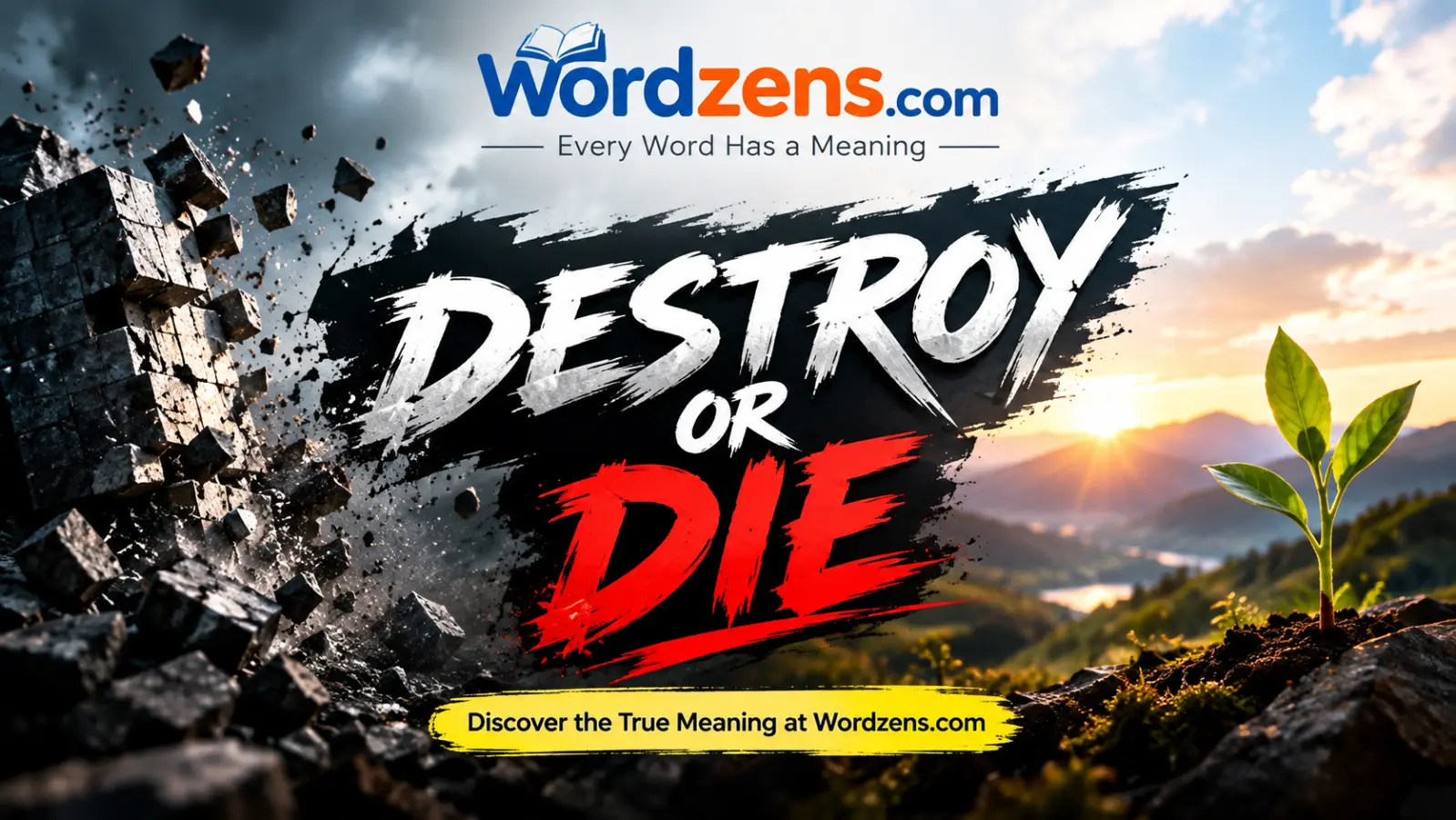
Ever read a sentence and paused, wondering if the writer meant something would be destroyed or that something would die? You’re not alone. Both words carry heavy, dramatic weight, and both show up in headlines, action movies, and everyday warnings, which is exactly why people blur the line between them.
One word talks about breaking something down completely, while the other talks about life ending. They sound like they belong to the same emotional family, so it’s easy to swap them in casual writing or speech.
Although they look/sound similar, they serve completely different purposes. By the end of this article, you’ll know exactly when to reach for each one, with zero guesswork left behind.
Section 1: What Is Destroy ?
Destroy is a verb that means to ruin something so completely that it can no longer exist, function, or be repaired. It applies to objects, systems, ideas, relationships, buildings, ecosystems, and even abstract things like hope or trust. When you destroy something, you’re not just damaging it a little; you’re wiping it out entirely.
How it’s used: Destroy is almost always paired with a direct object. You destroy something. It’s rarely used without naming what’s being wrecked.
Where it’s used: This word is standard across both American and British English, with no spelling or grammar differences between the two. It shows up in legal documents (destruction of property), military language (destroy the enemy base), environmental writing (destroy a habitat), and everyday conversation (my dog managed to destroy my sneakers).
Examples in sentences:
- The wildfire moved so fast it began to destroy entire neighborhoods within hours.
- A single harsh comment can destroy someone’s confidence for years.
- Engineers had to destroy the old bridge before construction could begin.
- Bad habits slowly destroy even the healthiest routines.
Historical/usage note: The word traces back to the Old French destruire, rooted in the Latin destruere, meaning “to unbuild” or “tear down.” That “unbuilding” idea is still baked into the modern meaning — destroy is fundamentally about undoing something that was made or built.
Section 2: What Is Die ?
Die is a verb that means to stop living. It refers to the end of biological life in humans, animals, and plants. It’s also used figuratively to describe something fading out, ending, or losing energy, like a conversation, a trend, or a flame.
How it’s used: Die is typically an intransitive verb, meaning it doesn’t take a direct object the way destroy does. Something simply dies; you don’t “die” another thing (that would require a different word, like “kill”).
Where it’s used: Die is used identically in US and UK English, with no regional spelling differences. You’ll see it in medical contexts (the patient died peacefully), casual speech (my phone battery died again), and figurative expressions (the trend died out by 2020).
Examples in sentences:
- The old oak tree finally died after the harsh winter storm.
- Without water, most houseplants will die within a couple of weeks.
- The party started strong, but the energy died down after midnight.
- He joked that he’d rather die than sing karaoke in public.
Regional/grammatical notes: One quirky detail: die has a present participle spelling change. It becomes “dying,” not “dieing.” This trips up a lot of writers, so it’s worth remembering as its own little rule.
Historical/usage note: Die comes from the Old Norse deyja, brought into English through Norse influence during the Viking settlements in Britain. Before this borrowing, Old English mostly relied on other words for death, which shows how deeply Norse language shaped everyday English vocabulary.
Key Differences Between Destroy and Die
Here’s a quick breakdown before we get to real conversations:
- Destroy needs an object; die usually doesn’t.
- Destroy applies to things, systems, or ideas; die applies to living beings or figurative “life” (like trends or conversations).
- Destroy is an active, deliberate or forceful action; die is often a natural or passive process.
- Destroy can be reversed only through complete rebuilding; die is permanent for living things.
- Destroy is transitive (someone destroys something); die is intransitive (something just dies).
Comparison Table
| Feature | Destroy | Die |
|---|---|---|
| Part of speech | Transitive verb | Intransitive verb |
| Needs a direct object? | Yes | No |
| Applies to | Objects, systems, ideas, relationships | Living things, figurative “life” |
| Nature of action | Active/forceful | Natural/passive |
| Reversibility | Only through rebuilding | Permanent (for living things) |
| Present participle | Destroying | Dying (note spelling change) |
| US vs UK spelling | Same | Same |
| Common collocations | Destroy evidence, destroy a city | Die peacefully, die out, die down |
Real-Life Conversation Examples
Dialogue 1: The Gaming Argument
Alex: Dude, my character just got destroyed in that boss fight. Sam: Wait, did you actually die though, or just lose health? Alex: No, I died. Game over screen and everything. Sam: Ha, so you didn’t just get destroyed, you got fully wrecked.
🎯 Lesson: “Destroyed” can describe a heavy defeat, but “died” specifically means the character’s life or game ended.
Dialogue 2: The Garden Disaster
Mia: The frost came in overnight and my tomato plants died. Jon: Oh no, did it destroy the whole garden or just a few plants? Mia: Mostly just the tomatoes. The herbs survived somehow.
🎯 Lesson: Die refers to the plants losing life, while destroy refers to the broader damage across the whole garden.
Dialogue 3: The Office Chat
Priya: This deadline is going to destroy me. Ravi: Relax, nobody’s actually going to die over a spreadsheet. Priya: Feels like it might, honestly.
🎯 Lesson: “Destroy” here is figurative for overwhelming stress, while “die” is used humorously to mean literal death, showing the contrast in tone.
Dialogue 4: The Old Car
Grandpa: That car finally died on the highway last week. Grandson: Did the engine just die, or did something destroy it completely? Grandpa: The engine died first, then the tow truck driver said it wasn’t worth fixing.
🎯 Lesson: A machine can “die” (stop working) without being fully “destroyed” (damaged beyond any repair).
Dialogue 5: The Movie Night
Lena: In this movie, the whole city gets destroyed by aliens. Theo: Does the main character die though? Lena: No spoilers, but let’s just say not everyone survives the destruction.
🎯 Lesson: A city can be destroyed as a setting-level event, while individual characters can separately die within that story.
When to Use Destroy vs Die
Practical usage rules:
- Use destroy when talking about damaging or eliminating a thing, system, or abstract concept beyond repair.
- Use die when talking about the end of biological life, or figuratively about something losing energy or fading away.
- If you can ask “destroy what?” and answer with a noun, destroy is correct. If the subject simply stops existing or functioning on its own, die fits better.
Simple memory tricks:
- Think: Destroy needs a Direct object. No object, no destroy.
- Think: Die is something that just happens; nobody actively “dies” someone else (you’d say “kill” for that).
- Picture destroy as a wrecking ball hitting a building, and die as a candle flame slowly going out on its own.
US vs UK writing: Good news here: both words are spelled and used the same way in American and British English. There’s no need to adjust spelling or grammar when switching between the two dialects. The only thing to watch is regional word choice in surrounding context, not the words themselves.
Fun Facts or History Section
- The word destroy shares its root with “construct,” just with the opposite prefix meaning. “Con-struere” means to build together, while “de-struere” means to tear apart, so the two words are essentially grammatical opposites built from the same base.
- Die is one of the relatively few common English verbs borrowed from Old Norse rather than Old English or Latin, alongside words like “sky,” “skin,” and “window.” This is a linguistic fingerprint left by Viking settlers over a thousand years ago.
FAQs:
Q1: Can “destroy” ever be used without an object?
No, destroy is a transitive verb, so it always needs a direct object naming what’s being destroyed.
Q2: Is “die” ever used to describe an object instead of a living thing?
Yes, figuratively. Machines, phone batteries, and even conversations can “die” when they stop working or fading out.
Q3: What’s the correct present participle of “die”?
It’s “dying,” not “dieing.” The “ie” changes to “y” before adding “-ing.”
Q4: Are there British vs American spelling differences between destroy and die?
No, both words are spelled and used identically in US and UK English.
Q5: What word should I use if someone causes another person or thing to die?
Use “kill,” since “die” itself cannot take a direct object.
Conclusion:
At the end of the day, destroy and die might sound like they belong to the same dramatic vocabulary family, but they work in very different ways.
Destroy is an active verb that needs a target, something being wrecked, ruined, or wiped out completely. Die, on the other hand, describes the natural or figurative end of life, and it doesn’t need an object at all.
Once you remember that destroy always needs something to act on, while die simply describes something ending on its own, the confusion disappears for good. Next time someone uses these two words, you’ll know exactly what they mean!

I’m Peter Jones, the founder of Wordzens.com. I’m passionate about creating clear language guides, word meanings, grammar resources, and educational content that helps readers expand their vocabulary, improve their communication, and learn with confidence. My goal is to publish high-quality, easy-to-understand content that makes learning words and language skills simple, useful, and enjoyable for readers of all levels.