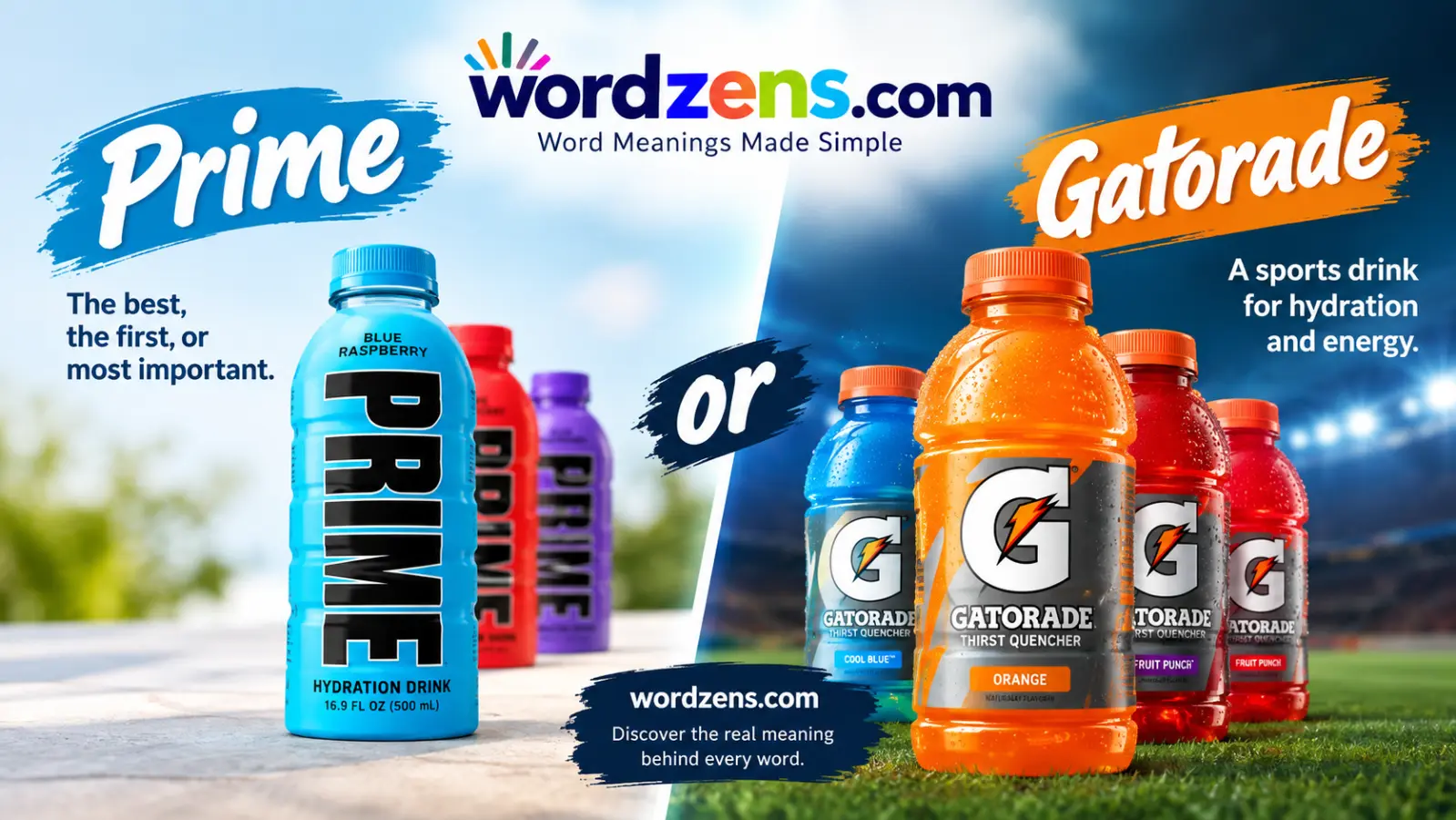
Walk into any gas station or gym today, and you’ll spot two bottles fighting for the same shelf space: one wrapped in bright, punchy colors with a logo backed by YouTubers, and the other a classic bottle that’s been sitting in coolers since your parents’ high school days.
Prime and Gatorade get mentioned in the same breath so often that a lot of people assume they’re basically the same drink with different labels. That mix-up makes sense — both are colorful, both promise “hydration,” and both show up at every sports practice, gym bag, and vending machine in sight.
But here’s the thing: although they look and sound similar in the sports-drink aisle, they serve completely different purposes.
One was built on decades of sports science research. The other launched in 2022 riding a wave of social media hype. By the end of this article, you’ll know exactly which one to grab and why.
What Is Prime?
Prime is a beverage brand launched in 2022 by internet personalities Logan Paul and KSI. It actually covers two separate product lines: Prime Hydration, a sports drink meant to replace fluids and electrolytes, and Prime Energy, a caffeinated energy drink. When people say “Prime” in casual conversation, they almost always mean the hydration version — the one in the sleek, colorful bottle.
Prime Hydration is marketed as a lighter, “cleaner” alternative to traditional sports drinks. It contains electrolytes, coconut water, and B vitamins, and it’s typically lower in sugar than many of its competitors. It’s sold in flavors like Blue Raspberry, Tropical Punch, and Lemon Lime, and its bottles are instantly recognizable thanks to bold, gradient-colored packaging.
Where it’s used: Prime is sold worldwide, but it exploded first in the United States and United Kingdom, largely because of its founders’ massive online followings. You’ll find it in convenience stores, big-box retailers, and increasingly in school vending machines, though some schools have restricted it due to caffeine concerns in the Energy line.
Examples in sentences:
- “Can you grab me a Prime from the fridge? I’m dying of thirst.”
- “My kid only wants Prime in his lunchbox because his friends all drink it.”
Usage note: Prime’s rapid rise is largely a marketing story. It didn’t build its reputation through decades of athletic sponsorships — it built it through viral unboxing videos and resale hype, with bottles once selling for absurd markups on secondary markets.
What Is Gatorade?
Gatorade is a sports drink developed in 1965 by researchers at the University of Florida, originally to help the school’s football team, the Gators, stay hydrated during brutal Florida heat. It was one of the first drinks specifically engineered to replace electrolytes — sodium, potassium, and fluids — lost through sweat during intense exercise.
Gatorade uses a formula built around glucose and electrolytes, and it’s been refined and studied for close to sixty years. It comes in dozens of flavors and multiple product lines, including Gatorade Thirst Quencher, Gatorade Zero (sugar-free), and Gatorade Fit.
Where it’s used: Gatorade is a household name across the United States and is widely available in Canada, the UK, and many other countries. It’s the official sports drink of major leagues like the NFL, and it’s a staple on the sidelines of everything from Little League games to the Olympics.
Examples in sentences:
- “Coach handed out Gatorade after practice to help everyone rehydrate.”
- “I always keep a bottle of Gatorade in my gym bag during summer training.”
Usage note: Gatorade’s history is rooted in actual sports science. Its formula has been backed by published research and used by professional athletic trainers for generations, which is a big part of why it still dominates locker rooms today.
Key Differences Between Prime and Gatorade
Both drinks aim to hydrate you, but the similarities mostly stop there.
- Origin: Gatorade came from a university sports science lab in 1965; Prime came from social media influencers in 2022.
- Brand positioning: Gatorade markets itself on performance science; Prime markets itself on lifestyle and celebrity appeal.
- Sugar content: Prime Hydration generally contains less sugar per bottle than regular Gatorade Thirst Quencher.
- Product range: Gatorade offers a wider range built specifically for athletic performance; Prime’s range is smaller and leans more general-purpose.
- Caffeine: Prime Energy contains caffeine, while Prime Hydration and standard Gatorade Thirst Quencher do not.
- Sports endorsements: Gatorade has deep, long-standing ties to professional leagues; Prime’s promotion is driven mainly by influencer marketing.
Comparison Table
| Feature | Prime | Gatorade |
|---|---|---|
| Founded | 2022 | 1965 |
| Founders/Origin | Logan Paul & KSI | University of Florida researchers |
| Main purpose | Hydration (and energy, in the Energy line) | Electrolyte and fluid replacement for athletes |
| Sugar level | Generally lower | Moderate to higher (varies by product) |
| Caffeine | Only in Prime Energy | None in classic Thirst Quencher |
| Sports affiliation | Limited/emerging | Official partner of major leagues (e.g., NFL) |
| Marketing style | Influencer and social media driven | Athletic science and sponsorship driven |
| Global reach | Growing, strongest in US/UK | Long-established worldwide |
Real-Life Conversation Examples
Dialogue 1
- Sam: “Grab me a Gatorade from the cooler, will you?”
- Alex: “We only have Prime, is that okay?”
- Sam: “Wait, aren’t those the same thing?”
- Alex: “Nope, totally different drinks — Prime just looks similar because of the marketing.”
🎯 Lesson: People often use “Gatorade” as a generic term for any sports drink, even when they actually mean Prime.
Dialogue 2
- Coach: “Bring extra Gatorade for the team today, it’s going to be hot.”
- Player: “Can I bring Prime instead? I like the flavors better.”
- Coach: “Sure, just make sure it’s the Hydration one, not the Energy one — no caffeine before a game.”
🎯 Lesson: Coaches care about the caffeine difference, which is something Gatorade’s classic formula simply doesn’t have.
Dialogue 3
- Mia: “My little brother only drinks Prime now. He says Gatorade is ‘old school.'”
- Jordan: “Old school built the whole sports drink industry, though.”
- Mia: “True, but try telling a ten-year-old that.”
🎯 Lesson: Prime’s appeal is largely generational, driven by influencer culture rather than sports science credibility.
Dialogue 4
- Tourist: “Do you have Gatorade?”
- Shopkeeper: “We have Prime, is that fine?”
- Tourist: “Is it the same thing?”
- Shopkeeper: “Similar idea, different brand — Prime’s newer and a bit less sugary.”
🎯 Lesson: In everyday conversation, the two names sometimes get swapped simply out of habit, not accuracy.
Dialogue 5
- Trainer: “For serious workouts, I still recommend Gatorade — it’s been tested for decades.”
- Client: “What about Prime? Everyone’s talking about it.”
- Trainer: “It’s fine for casual hydration, just not built the same way for heavy athletic performance.”
🎯 Lesson: For intense training, Gatorade’s research-backed formula still holds more credibility with professional trainers.
When to Use Prime vs Gatorade
- Use Gatorade when you want a drink with a long track record in athletic performance and electrolyte replacement, especially for intense workouts, hot weather, or organized sports.
- Use Prime when you want a lighter-tasting, lower-sugar hydration option for everyday drinking, or when the caffeinated Energy version fits your routine (never before youth sports, due to caffeine).
Simple memory trick: Think “Gatorade = Game day,” since it’s the one you’ll see on actual sidelines and locker rooms. Think “Prime = Pop culture,” since its popularity is tied closely to social media trends.
US vs UK note: In the US, Gatorade is the default sports drink in most athletic settings, while Prime is more common in casual, youth-driven contexts. In the UK, Prime saw an especially fast rise thanks to KSI’s massive local fanbase, sometimes even outselling Gatorade in convenience stores during its early hype years.
Fun Facts or History
- Gatorade’s original formula reportedly tasted so unpleasant that early testers nearly rejected it — it only caught on after the Florida Gators football team started winning more games and crediting the drink.
- Prime became so hyped at launch that some bottles were resold online for many times their retail price, leading some stores to limit how many bottles a single customer could buy.
FAQs:
Q: Is Prime healthier than Gatorade?
A: Prime Hydration generally has less sugar than regular Gatorade, but “healthier” depends on your specific needs — athletes doing intense training may still benefit more from Gatorade’s electrolyte profile.
Q: Does Prime have caffeine?
A: Only Prime Energy contains caffeine. Prime Hydration, the more common bottle, does not.
Q: Which one is better for kids?
A: Prime Hydration and classic Gatorade Thirst Quencher are both caffeine-free and generally fine in moderation, but Prime Energy should be avoided for children due to its caffeine content.
Q: Why did Prime become so popular so fast?
A: Prime’s rapid rise came from the massive online followings of its founders, Logan Paul and KSI, combined with limited early availability that created hype and resale demand.
Q: Is Gatorade still used by professional athletes?
A: Yes, Gatorade remains a major sponsor and staple in professional sports, including its long-standing partnership with the NFL.
Conclusion:
At the end of the day, Prime and Gatorade both aim to keep you hydrated, but they come from completely different worlds.
Gatorade is the veteran, built on real sports science and decades of trust from athletes and trainers. Prime is the newcomer, built on social media buzz, bold branding, and a younger audience’s appetite for the next big trend.
Neither one is “wrong” to choose — it really comes down to what you’re doing and what you’re looking for in a drink. Understanding these differences means you’ll never again get caught mixing up the two just because they happen to sit on the same store shelf.
Next time someone uses these two words, you’ll know exactly what they mean!

I’m Peter Jones, the founder of Wordzens.com. I’m passionate about creating clear language guides, word meanings, grammar resources, and educational content that helps readers expand their vocabulary, improve their communication, and learn with confidence. My goal is to publish high-quality, easy-to-understand content that makes learning words and language skills simple, useful, and enjoyable for readers of all levels.