
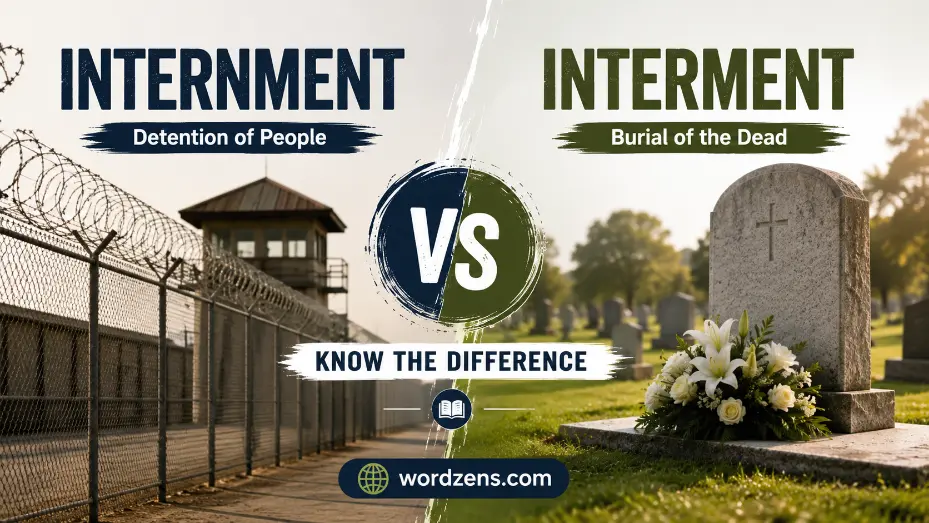
Have you ever stopped while speaking because a word seemed correct yet something was wrong? That is often what occurs with internment and interment. Internment and interment are two of the frequently mixed terms in English and it is easy to see why.
The spellings of internment and interment are the same the pronunciations of internment and interment are nearly identical and both words appear in serious weighty contexts such, as history books, obituaries and legal documents.
A single misplaced letter can change the meaning of your sentence sometimes confusing sometimes appearing careless or even disrespectful.
Even though internment and interment look and sound alike they have different meanings. Internment refers to confinement. Interment refers to burial. Once you notice this pattern you will never lose it again.
What Is Internment?
Internment is the act of confining or detaining someone, usually for political or wartime reasons, without a formal criminal trial. It’s a term you’ll run into most in history, law, and government policy writing.
At its core, it means holding a person or group somewhere a camp, a facility because they’re seen as a threat, an enemy national, or some kind of security risk during a conflict. It’s worth noting this isn’t the same thing as imprisonment for a crime. There’s no trial. It’s a government or military decision, not something a court hands down.
Where You’ll See It
This word shows up constantly in historical, legal, and journalistic writing. A few common contexts:
- Wartime policies, like the detention of Japanese Americans during World War II
- Refugee and immigration detention
- Political confinement without trial
It’s a noun, and it tends to pair with words like camp, policy, and order. You’ll see “internment camp” far more often than the alternate spelling and that mix-up isn’t a small one. It changes what the sentence is actually saying.
A few examples:
- The government’s internment policy during the war affected thousands of families.
- Historians still argue about the ethics of the camps built in the 1940s.
- Her grandfather spent two years in a detention facility after being labeled an enemy alien.
One of the most studied examples of internment is what happened to Japanese Americans in the U.S. during World War II. After Executive Order 9066 in 1942, more than 100,000 people of Japanese descent many of them citizens were forced into camps. It’s still discussed heavily in textbooks and legal debates about civil liberties, and for good reason.
What Is “Interment”?
Now for the other one. Interment has nothing to do with detention it’s the act of burying a deceased person, typically as part of a funeral.
This is the formal word for burial: placing a body, or sometimes cremated remains, into the ground, a tomb, or a vault. You’ll come across it most in obituaries, funeral programs, and religious or ceremonial writing.
Here’s the spelling difference, and it’s subtle: one version has an extra “n,” the burial-related word doesn’t. Think of “inter,” the root verb, which just means to bury. That single letter is really the whole difference between a funeral notice and a wartime record.
Where it shows up:
- Obituaries and death notices
- Funeral and cemetery paperwork
- Religious or cultural burial ceremonies
- Legal documents tied to estates and cemeteries
It’s also a noun, and it pairs with words like service, ceremony, and site. A funeral program might say “burial to follow at [Cemetery Name]” that’s telling people when the ceremony happens.
A few examples:
- The burial will take place right after the memorial service.
- Family members gathered quietly for the private ceremony.
- The cemetery’s records show the exact date for each grave.
This is a word steeped in tradition. It’s used the same way in American and British English no real regional split though you’ll see it more in formal writing, like obituaries, than in casual speech, where people just say “burial.”
Key Differences at a Glance
- One is about confinement or detention, often for political or wartime reasons
- The other is about burying a deceased person
- The confinement word has two n’s; the burial word has one
- One connects to camps, policies, detention centers
- The other connects to funerals, cemeteries, burial services
- Both are nouns, but they live in completely different worlds
- Confusing them can make a sentence unclear, or worse, come off as tone-deaf
Comparison Table
| Feature | Internment | Interment |
|---|---|---|
| Meaning | Detention or confinement, often political or wartime | Burial of a deceased person |
| Root word | “Intern,” to confine | “Inter,” to bury |
| Spelling | Two n’s | One n |
| Common pairings | Camp, policy, order, facility | Service, ceremony, site, burial |
| Typical context | History, law, politics, war | Funerals, obituaries, cemeteries |
| Tone | Somber, often controversial | Solemn, ceremonial |
| Example phrase | “Detention camp order” | “Burial service to follow” |
Real-Life Conversation Examples
Dialogue 1
Sarah: I read that her great-grandfather was held in a camp during the war, and the article called it interment. Mike: Pretty sure that should be internment interment’s for burials. Sarah: Oh wow, that’s a big difference. Good catch.
Lesson: One wrong letter turns a burial word into a detention word, so it’s worth a second look before you hit publish.
Dialogue 2
James: The funeral home said the internment will be at 3 PM tomorrow. Lily: I think you mean interment. Internment’s what happened to people during the war, not a burial. James: Ha, you’re right. I always get those backwards.
Lesson: For anything funeral-related, the burial spelling is almost always the one you want.
Dialogue 3
Teacher: Who can tell me what happened to Japanese Americans in 1942? Student: They were sent to interment camps? Teacher: Close it’s internment camps. That extra letter’s a decent memory hook for confinement.
Lesson: Even in classrooms this pair trips people up constantly, so linking the double letter to confinement helps it stick.
Dialogue 4
Emma: The obituary said the interment service is private, family only. Noah: Got it so nothing about detention camps happening here. Emma: Right. Definitely not the same word, Noah.
Lesson: Treating these as interchangeable can land badly, since one’s about grief and the other’s tied to a painful chapter of history.
Dialogue 5
Writer: I used “internment” writing about my grandmother’s funeral. Wrong word? Editor: Yep should be “interment.” The other one’s for camps and detention. Writer: Glad you caught that before it went out.
Lesson: Even experienced writers slip on this one, which is exactly why a second pass matters.
When to Use Internment vs Interment
- Use the confinement word for anything involving detention or imprisonment political, wartime, or legal writing.
- Use the burial word for anything involving funerals or cemetery services.
- Body, casket, grave in the sentence? You want the burial term.
- Camp, prisoner, policy in the sentence? You want the confinement term.
A couple of memory tricks that actually work: the confinement word has that extra “n,” and so does the word “confinement” easy link. The burial word has just one “n,” which matches how simple and final a single grave is. Or just picture a camp for one and a cemetery for the other. That image alone usually settles it.
As for regional differences there really aren’t spelling ones, unlike “color” versus “colour.” But usage does skew a bit. The confinement word shows up more in American historical writing, largely because of the WWII camps. The burial word tends to appear more in British obituaries and formal funeral notices, which lean traditional.
A Couple of Fun Facts
The root behind the word comes from the Latin word internus, which means “internal” – that makes sense because confinement means being inside a limit. The root for the burial word is interrare, which means “to bury in the earth”; this root shows up in other burial words, in Romance languages.
FAQs:
1. What is the difference between internment and interment?
Internment refers to the detention of people while interment refers to the burial of a person.
Even though the words look similar internment and interment have meanings.
2. Does internment mean burial?
No. Internment is about detention; interment is about burying something or someone.
3. What is meant by interment?
Interment means burying someone who’s dead. For example you could say: “The family attended the interment after the funeral service.”
4. What is meant by internment?
Internment is the detention of a person for example in a camp where the person is suspected of being an enemy of the state but cannot be prosecuted.
5. How to distinguish internment and interment?
To remember the difference note that interment, from the letter “e ” is linked to burial.
Conclusion:
Internment vs Interment two words actually mean very different things. One word is about confinement. Things like camps, policies, detention. Often connects to some of the darker parts of history.
The other word is softer more respectful tied to burial and remembrance. Mixing them up isn’t a small mistake. It can change the mood of your writing.
If you need a trick remember this: the word, with the extra letter points to confinement. The simpler version belongs to the ground. Where people rest. Time you see these two words you’ll know exactly which one is which.

I’m Peter Jones, the founder of Wordzens.com. I’m passionate about creating clear language guides, word meanings, grammar resources, and educational content that helps readers expand their vocabulary, improve their communication, and learn with confidence. My goal is to publish high-quality, easy-to-understand content that makes learning words and language skills simple, useful, and enjoyable for readers of all levels.