
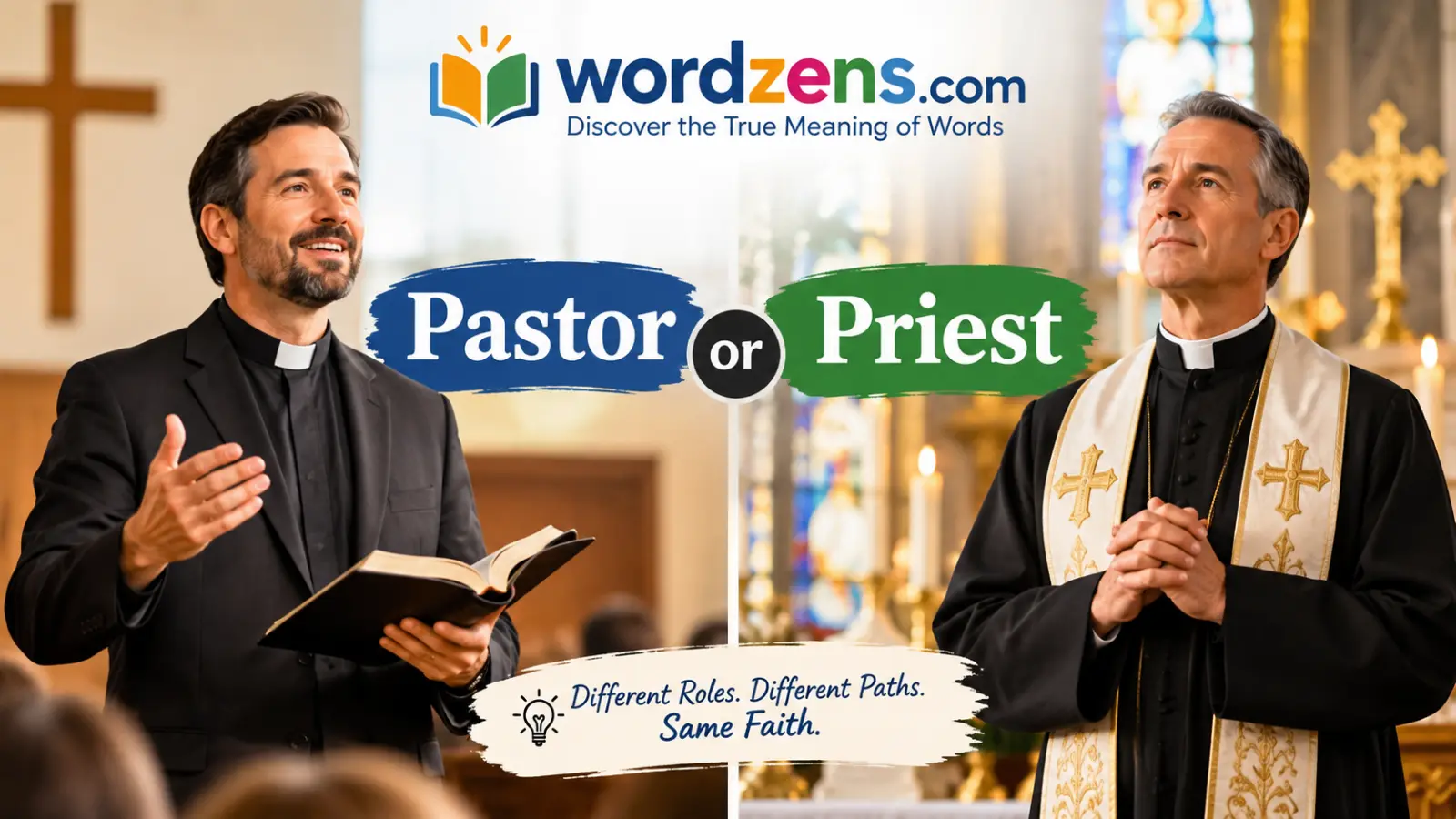
Ever sat in a conversation and heard someone call a religious leader a “pastor” while another person calls the same kind of leader a “priest”? You’re not alone if you’ve felt a little confused. These two words get mixed up all the time even by people who grew up going to church.
The confusion makes sense. Both words describe someone who leads a religious community guides people spiritually and performs ceremonies like weddings and funerals. On the surface they seem almost interchangeable.
Although they look and sound similar they serve completely different purposes. A pastor and a priest come from different religious traditions have different responsibilities and even follow different rules around things like marriage and ordination. This guide breaks it all down in simple friendly language so you’ll never mix them up again.
What Is a Pastor ?
A pastor is a religious leader most commonly found in Protestant Christian churches. The word comes from the Latin term for “shepherd” which fits perfectly since a pastor’s main job is to guide and care for their congregation the way a shepherd cares for a flock.
How It’s Used
A pastor typically leads a local church community. Their responsibilities usually include:
- Preaching sermons during weekly services
- Teaching Bible studies
- Counseling members of the congregation
- Performing weddings baptisms and funerals
- Overseeing the day to day operations of the church
Pastors are found in Baptist Methodist Lutheran Presbyterian Pentecostal and many other Protestant denominations. Unlike some religious leaders pastors can usually marry and have families. In many Protestant traditions women can also become pastors depending on the denomination.
Examples in Sentences
- “Our pastor gave an inspiring sermon about forgiveness this Sunday.”
- “She’s been the pastor of this congregation for over ten years.”
- “We asked the pastor to officiate our wedding ceremony.”
A Short Usage Note
In the United States the title pastor is extremely common and widely recognized especially in evangelical and nondenominational churches. It’s a title that emphasizes relationship and spiritual guidance rather than sacramental authority.
What Is a Priest ?
A priest is a religious leader most often associated with the Roman Catholic Church Eastern Orthodox Church and Anglican or Episcopal traditions. Priests hold a specific ordained role that gives them the authority to perform sacraments.
How It’s Used
A priest‘s duties often include:
- Celebrating Mass and administering the Eucharist
- Hearing confessions and offering absolution
- Performing baptisms marriages and last rites
- Leading structured liturgical services
- Serving under a bishop within a church hierarchy
In the Roman Catholic Church priests are required to remain celibate and unmarried as part of their commitment to the priesthood. This is a major difference from pastors. In Eastern Orthodox traditions married men can become priests but they must marry before ordination not after.
Examples in Sentences
- “The priest blessed the congregation at the end of Mass.”
- “We went to confession with our parish priest last weekend.”
- “He studied for years in seminary before becoming a priest.”
Regional and Grammatical Notes
The title priest is used across many countries with Catholic or Orthodox populations including Italy Ireland the Philippines Poland and Mexico. In the Anglican and Episcopal churches both men and women can be ordained as priests depending on the specific branch and country.
Key Differences Between Pastor and Priest
Here’s a quick breakdown of how these two roles differ.
Quick bullet summary:
- A pastor usually leads a Protestant church while a priest usually leads a Catholic Orthodox or Anglican parish
- Pastors can generally marry while Catholic priests must remain celibate
- Priests perform sacraments like the Eucharist and confession while pastors focus more on preaching and teaching
- Priests operate within a strict hierarchy under bishops while pastors often have more independence
- Some Protestant denominations allow women pastors while the Catholic Church does not ordain women priests
Comparison Table
| Feature | Pastor | Priest |
|---|---|---|
| Religious Tradition | Protestant Christianity | Catholic Orthodox Anglican |
| Can Marry | Usually yes | No for Catholic priests |
| Performs Sacraments | Limited | Central to the role |
| Hierarchy | Often independent or congregational | Reports to a bishop |
| Ordination Path | Varies by denomination | Seminary and formal ordination |
| Women Allowed | Yes in many denominations | No in Catholic Church |
| Focus | Preaching teaching counseling | Sacraments liturgy tradition |
Real Life Conversation Examples
Dialogue 1
Maria: “Is Father Tom a pastor or a priest?” Jake: “He’s a priest. That’s why everyone calls him Father.”
🎯 Lesson: The title “Father” is a strong clue that someone is a priest not a pastor.
Dialogue 2
Sam: “I heard your pastor just got married. Congrats to them!” Nina: “Yeah pastors can marry. It’s priests who usually can’t.”
🎯 Lesson: Marriage rules are one of the clearest ways to tell the two roles apart.
Dialogue 3
Leo: “Who’s giving the sermon on Sunday?” Amy: “Our pastor is. He’s been prepping all week.” Leo: “Oh I thought your church had a priest.” Amy: “No we’re Baptist so we have a pastor.”
🎯 Lesson: The denomination usually determines whether the leader is called a pastor or a priest.
Dialogue 4
Dev: “Can women be priests?” Priya: “Not in the Catholic Church but plenty of Protestant churches have women pastors.”
🎯 Lesson: Gender rules for religious leadership differ sharply between these two titles.
Dialogue 5
Chris: “Are you going to confession with the priest today?” Alex: “That’s a Catholic thing. My pastor doesn’t do confession like that.”
🎯 Lesson: Confession as a formal sacrament is tied to the priesthood not the pastorate.
When to Use Pastor vs Priest
Getting this right comes down to a few practical rules.
- Use pastor when referring to leaders in Protestant Baptist Methodist Lutheran Pentecostal or nondenominational churches
- Use priest when referring to leaders in Catholic Orthodox or Anglican churches
- If the leader is addressed as “Father” they’re almost certainly a priest
- If the leader is addressed by their first name plus “Pastor” like “Pastor John” they’re a pastor
- When writing for a US audience remember that both terms are common but context and denomination decide which one fits
- When writing for a UK audience note that Anglican leaders are usually called priests or vicars while Protestant nonconformist leaders are called pastors or ministers
Simple memory trick: Priest starts like “priesthood” which connects to ancient sacred ritual and hierarchy. Pastor starts like “pasture” which connects to shepherding and guiding a flock day to day.
Fun Facts and History
The word pastor has roots going back to the Latin word for shepherd and it appears in the Bible describing spiritual leaders who “feed” and guide their flock.
The word priest traces back through Old English and Latin to the Greek word “presbyteros” meaning elder which is also where we get the word Presbyterian even though Presbyterian churches actually use pastors not priests.
FAQs:
Can a pastor become a priest?
Not directly. Someone would need to go through the specific ordination process required by the Catholic Orthodox or Anglican church they wish to join.
Do pastors and priests get paid the same way?
It varies widely. Both roles can involve a salary or stipend but the structure often depends on the denomination and whether the leader serves a large or small congregation.
Is a priest higher ranking than a pastor?
Not exactly higher ranking since they belong to different systems entirely. Priests operate within a formal hierarchy under bishops while pastors often lead independently or under a denominational board.
Can you call a priest “pastor”?
It’s uncommon but not unheard of especially in some Anglican contexts. Generally though it’s best to use the correct title for the tradition.
Why do some churches have both pastors and priests?
Some larger denominations or nondenominational movements use both titles for different staff roles though this is less common than sticking to one title based on tradition.
Conclusion:
So next time you hear someone say pastor or priest you’ll know exactly what sets them apart. A pastor typically leads a Protestant congregation focuses on preaching and teaching and can usually marry.
A priest belongs to a Catholic Orthodox or Anglican tradition performs sacraments like Mass and confession and often follows stricter rules around celibacy and hierarchy.
Both roles matter deeply to their communities even though their paths titles and responsibilities differ. Next time someone uses these two words you’ll know exactly what they mean!

I’m Peter Jones, the founder of Wordzens.com. I’m passionate about creating clear language guides, word meanings, grammar resources, and educational content that helps readers expand their vocabulary, improve their communication, and learn with confidence. My goal is to publish high-quality, easy-to-understand content that makes learning words and language skills simple, useful, and enjoyable for readers of all levels.