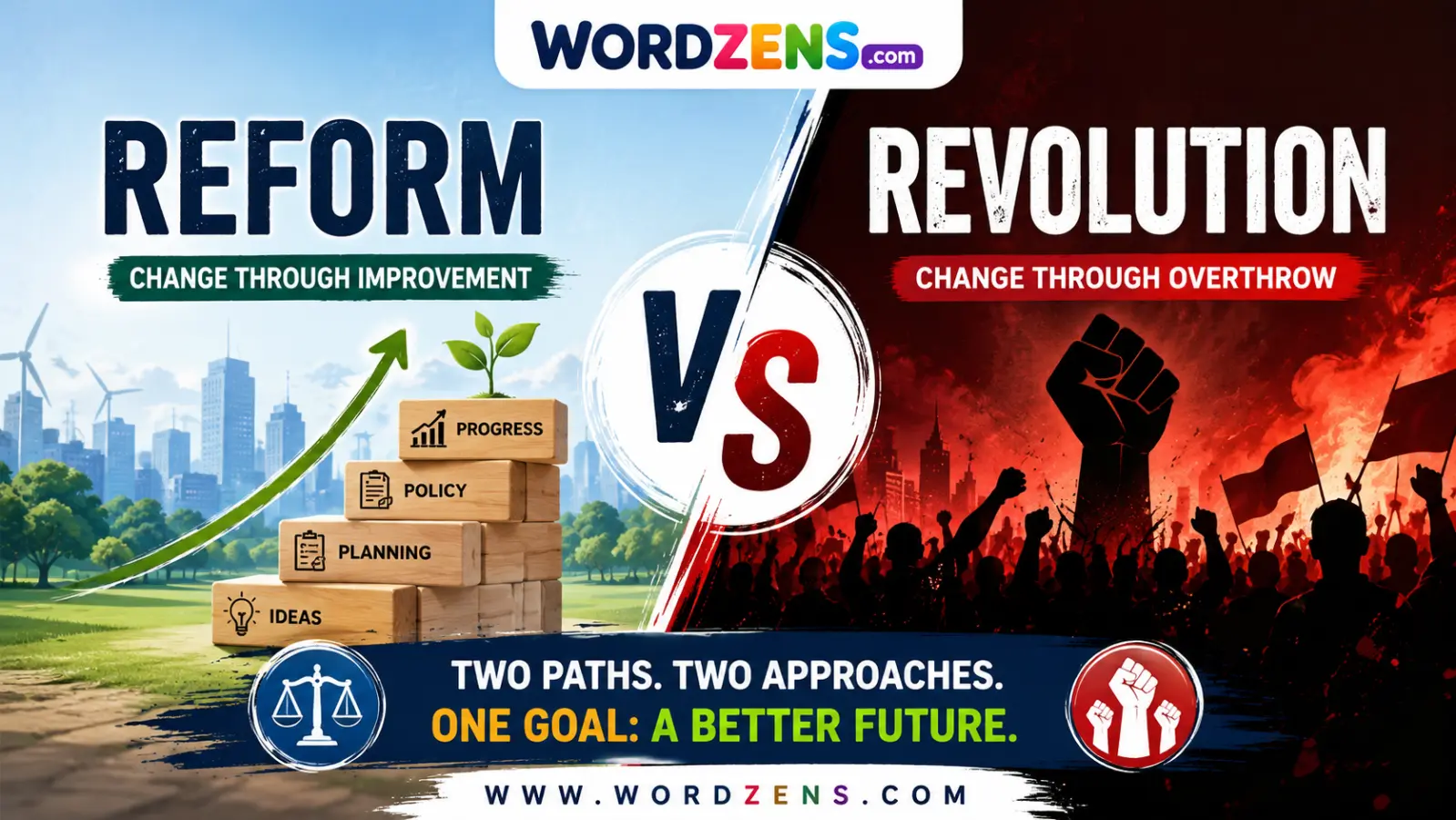
Reform vs revolution refers to contrasting approaches to dealing with political, social and economic changes in society. Coming from different roots, revolution and reform have different implications.
Generally, reform tends to emphasize slow and steady change within a political or social framework. Unlike reform, revolution goes further to radically redefine or overthrow the established order.
The concept of Reform vs Revolution is particularly interesting and debatable among students, history enthusiasts, and those interested in the background of social events.
This article provides a brief overview of reform and revolution, including examples and comparing reform vs revolution differences and advantages. Hopefully, the given information will help understand the concept of reform vs revolution better and distinguish between reform and revolution.
What is Reform ?
Reform means making something without starting over. You keep the part and fix the parts that aren’t working. It’s like fixing up a house instead of tearing it down and building a new one.
How its used
Reform can be a noun or a verb depending on the sentence. You might see “the government introduced a tax reform ” or “lawmakers want to reform the healthcare system.” It often comes with words, like policy, education, prison or land. Places where a system is being changed, not completely replaced.
Where it’s used
You’ll mostly run into reform in political, legal, and institutional writing, and this holds true in both American and British English. No spelling difference to worry about here.
A few examples
- The new education reform is supposed to fix how public schools get funded.
- Several countries have reformed their justice systems just to deal with overcrowding.
- She spent most of her career pushing for prison reform, long before it was popular to talk about.
A bit of history
Britain’s Reform Act of 1832 is a good example of this in action it changed who could vote without touching the monarchy or rebuilding the government from scratch. That’s reform doing what reform does: working inside the system rather than blowing it up.
What Is Revolution ?
Revolution goes further. It’s not a patch job it’s a full overthrow. The old system doesn’t get adjusted, it gets removed, sometimes overnight. And revolutions aren’t only political. They can be technological, cultural, even personal, depending on the scale you’re talking about.
How it’s used
Almost always a noun “the French Revolution changed Europe” is the classic example though “revolutionary” gets used constantly as an adjective too, especially in marketing (“a revolutionary new product,” which, let’s be honest, isn’t always true). It naturally pairs with words like industrial, digital, cultural, and political.
Where it’s used
You’ll find revolution scattered across history, politics, science, and tech writing. Same spelling, same usage, whether you’re writing in American or British English.
A few examples
- The Industrial Revolution completely changed how goods got made.
- Smartphones triggered something close to a communication revolution.
- The French Revolution of 1789 put an end to centuries of monarchy, more or less overnight by historical standards.
A bit of history
Revolutions tend to earn their own place in the history books the American Revolution, the Russian Revolution, the Digital Revolution. Each one marks a point where people didn’t just tweak the old system. They rejected it outright.
Key Differences Between Reform and Revolution
- Reform improves what’s already there. Revolution gets rid of it and starts over.
- Reform tends to move slowly. Revolution can happen almost overnight.
- Reform stays inside existing laws and institutions. Revolution steps outside them, or fights against them.
- Reform usually involves negotiation. Revolution can be forced, chaotic, or completely unplanned.
- Both are forms of change — they just operate on a totally different scale.
Comparison Table
| Feature | Reform | Revolution |
|---|---|---|
| Definition | Gradual improvement of an existing system | Complete overthrow or replacement of a system |
| Pace | Slow | Fast |
| Method | Works within the system | Breaks from the system |
| Tone | Negotiated | Often dramatic |
| Example | Tax reform, education reform | French Revolution, Industrial Revolution |
| Word type | Noun / verb | Mostly noun |
| Goal | Fix and improve | Replace and transform |
Real-Life Conversation Examples
Dialogue 1
Amir: Did you hear the government passed a new labor law. Sara: Was it a revolution or just a reform. Amir: Just a reform, honestly. They adjusted the minimum wage rules, that’s about it.
Lesson: A reform adjusts the rules it doesn’t rewrite the whole system.
Dialogue 2
Teacher: Who can tell me what caused the monarchy to collapse in France. Student: A revolution, obviously. The whole government got overthrown.
Lesson: A revolution replaces the entire structure, not just a piece of it.
Dialogue 3
Maya: My company keeps calling it a “digital reform.” Jordan: That’s not a reform, that’s a revolution. They replaced every single system overnight.
Lesson: When change is sudden and total, “revolution” is the more accurate word.
Dialogue 4
Ali: The healthcare reform bill finally passed after years of arguing. Nina: So it’s still basically the same system, just cleaned up? Ali: Pretty much. Nothing got torn down, they just fixed the parts that were broken.
Lesson: Reform is improvement through negotiation, not demolition.
Dialogue 5
Kim: People keep calling AI a technological revolution. Leo: Fair enough it’s reshaping entire industries, not just adjusting them at the edges.
Lesson: When an entire industry shifts, “revolution” fits better than “reform.”
When to Use Reform vs Revolution
- Reach for reform when you’re talking about gradual changes to laws, policies, or institutions.
- Reach for revolution when you mean a total overthrow or complete transformation of something.
- If the change is slow and negotiated, it’s reform.
- If it’s sudden and total, it’s revolution.
A simple way to remember it
Reform sounds like repair. Revolution sounds like replace. That’s roughly the whole rule, and it holds up in most situations you’ll actually run into.
US vs UK usage
No real difference here spelling and grammar for both words stay the same across American and British English.
A Couple of Interesting Notes
“Revolution” actually started out as an astronomy term, used to describe a planet’s orbit around the sun, long before anyone applied it to politics or protest.
There’s also an argument historians make fairly often that failed reforms are frequently what cause revolutions in the first place. Refuse small changes for long enough, and people eventually start demanding a complete one instead.
FAQs:
1. What is the difference between Reform vs Revolution?
Reform means making changes over time to make a system better. Revolution means changing a system quickly and often in a big way.
2. Which is more peaceful, reform or revolution?
Reform is usually more peaceful because it happens slowly and uses the systems that’re already in place. Revolution can include protests, loud arguments or even fighting. Not all revolutions are violent though.
3. Is reform better than revolution?
It depends. Reform can bring steady changes. Revolution can bring changes when the old system does not want to change.
4. What is an example of reform?
An example of reform is changing rules about work to make things fairer for workers while keeping the rest of the system the same.
5. What is an example of a revolution?
The French Revolution is an example. It changed the way France was run and ended the rule of kings.
6. Can reform lead to revolution?
Yes. If changes do not work or are not accepted people can get more upset. This can lead to changes that are not gradual.
7. What is the main goal of reform?
The main goal of reform is to make a system better by fixing problems without starting
8. What is the main goal of a revolution?
The main goal of a revolution is to change a system quickly often replacing the way things are run.
9. What are the advantages of reform?
Reform can help things get slowly. It can avoid changes that might cause problems. It can also help systems change over time.
10. What are the disadvantages of revolution?
Revolutions can cause problems, like fighting, confusion and money issues. How bad it is depends on what happens and how it ends.
Conclusion
Reform vs Revolution are both, about change. Reform vs Revolution both of they lie at opposite ends of the line. Reform works with what exists fixing it step by step. Revolution removes the system and starts again usually quick and often messy.
Knowing which word fits a situation is important whether you are writing about politics, technology or events at your workplace.
Reform believes the system deserves to be saved. Revolution believes the system is not worth keeping. Time you hear either word you will know exactly which one is being talked about.

I’m Peter Jones, the founder of Wordzens.com. I’m passionate about creating clear language guides, word meanings, grammar resources, and educational content that helps readers expand their vocabulary, improve their communication, and learn with confidence. My goal is to publish high-quality, easy-to-understand content that makes learning words and language skills simple, useful, and enjoyable for readers of all levels.