Have you ever confused an inclusive or inclusiveness word with another? Both words are similar, but sometimes they may affect the particular meaning that you might want to convey.
The words inclusivity or inclusiveness imply the same thing – inviting and respecting people of different categories of the society and making them feel included and valued. However, to write a better text, you may want to choose the more appropriate and needed word.
If you have ever struggled with an inclusive or inclusiveness example, you are not alone. Many people learn English and often confuse these words. Moreover, this mistake is quite common even among native English speakers.
That is why in this article, you will learn the difference between the inclusivity vs. inclusiveness definition and see some simple examples of how these words may be used. After reading the article, you will forever be able to tell the difference between inclusivity and inclusiveness and will be confident enough to use both words in your daily writing.
What Is “Inclusivity”?
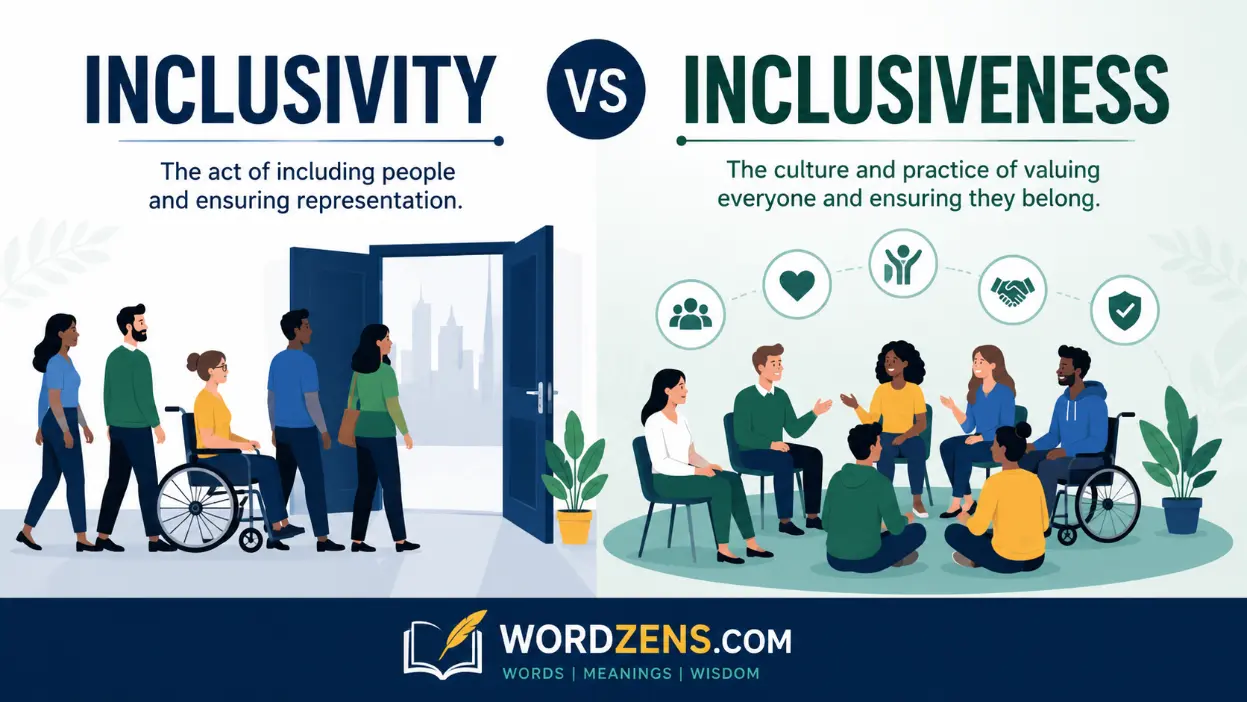
Inclusivity, at its very core, embodies the idea of incorporating those who might feel left out. Racially, gender-wise, sexually, in terms of disabilities, origins – you name it. Grammatically correct as a noun, it still holds a certain weight to it. Something that is done, rather than merely an existence.
You will run into it most in modern, workplace-y contexts. HR pages, marketing copy, classrooms, that ongoing conversation around diversity and social justice. It just has more energy behind it, and it tends to sit next to action words like “promote” or “foster” or “commit to.”
Both American and British English use it, though truthfully it did not really pick up steam until the last twenty-ish years, riding along with the corporate push around diversity and inclusion work. So compared to its counterpart, it is the newer one on the block, and its usage has climbed fast since somewhere around the early 2000s.
A few ways it shows up in a sentence:
The company launched a new training program to improve inclusivity across all departments. Our school prides itself on inclusivity, welcoming students from every background. The event organizers focused on inclusivity, making sure the venue was wheelchair accessible.
Small thing worth mentioning, language trackers show a pretty sharp jump in how often this word gets used starting around 2010. That lines up almost exactly with the rise of workplace diversity movements and, well, social media doing its thing. Which is probably why it feels like the “trendier” word of the pair, even now.
What Is “Inclusiveness”?
Now inclusiveness, this one is quieter. It describes a state, a quality that already exists rather than an effort still in motion. Something either has inclusiveness or it does not, if that makes sense.
You will see this word more in formal writing, academic papers, that sort of thing. It gets used when someone is describing what a group or system is like, not what steps are being taken to change it.
Like inclusivity, both US and UK English use this word, but it leans harder toward academic and government-type writing. And it is older too, been part of the language since the early 1900s, long before inclusivity ever entered the picture.
Here is roughly how it plays out in real writing:
The committee praised the inclusiveness of the new healthcare policy. Critics questioned the inclusiveness of the voting system. The report highlighted the inclusiveness of the curriculum design.
Both words function as abstract nouns grammatically, but inclusiveness tends to get treated as the more “proper” or traditional pick, the kind editors reach for out of habit when the tone needs to stay formal. Inclusivity is fully accepted in dictionaries now too, so it is not like one is wrong, they just carry different weight.
Key Differences Between Inclusivity and Inclusiveness
Both words are circling the same basic idea, not leaving anyone out. Where they split is tone and application, and it is a split worth paying attention to.
Inclusivity feels active, modern, kind of policy-driven. Inclusiveness feels older, more descriptive, focused on quality rather than action. One pairs naturally with verbs like “promote” or “improve,” the other with something like “reflects” or “demonstrates.” You will spot inclusivity more in corporate language and on social media, while inclusiveness shows up more in academic, legal, and government writing.
Here is that same idea laid out as a table, since sometimes seeing it side by side just clicks better:
| Feature | Inclusivity | Inclusiveness |
|---|---|---|
| Word type | Action-oriented | Describes a state |
| Tone | Modern, energetic | Formal, traditional |
| Common context | Workplace, DEI, social media | Academic, legal, government |
| Popularity | Growing fast since the 2010s | Steady for over a century |
| Typical pairing | “Promote inclusivity” | “Reflects inclusiveness” |
| Roughly when it took off | 2000s to 2010s | Early 1900s |
Real-Life Conversation Examples
Sara: Our new manager keeps talking about “inclusivity” in every meeting. Tom: Wait, is that not the same thing as inclusiveness? Sara: Kind of, but inclusivity sounds more like something we are actively working toward.
Lesson: inclusivity implies effort in motion, inclusiveness implies a trait that is already there.
Maya: The report praised the school’s inclusiveness. Alex: So it is already inclusive, not just trying to be? Maya: Right, inclusiveness is describing what already exists.
Lesson: inclusiveness usually describes a current state, not a future goal.
Jordan: Should I write “improve inclusivity” or “improve inclusiveness” for my essay? Priya: Either one works, honestly, but inclusivity reads more modern these days. Jordan: Cool, I will go with that for the blog post then.
Lesson: for blogs and casual content, inclusivity tends to be the safer bet.
Liam: My professor used “inclusiveness” in her lecture, is that outdated or something? Noor: Not outdated, just more formal. Academic writing leans that direction a lot. Liam: Ah, that tracks, it did sound pretty official.
Lesson: inclusiveness fits naturally into academic or formal writing.
Ben: Our mission statement literally says “commitment to inclusivity.” Grace: Yeah, that phrase is everywhere in corporate language now. Ben: True, it definitely sounds more action-driven than inclusiveness would.
Lesson: corporate and marketing language leans heavily toward inclusivity.
When to Use Inclusivity vs Inclusiveness
There is no perfect rulebook here, but a few things help. If you are talking about effort, about policies or actions aimed at bringing people in, inclusivity usually fits better. If you are describing something that is already inclusive, a trait, a quality, a fact about how a system works, inclusiveness tends to sound more natural.
For workplace blogs, HR pages, social posts, casual writing in general, inclusivity is probably your default. Academic papers, legal documents, formal reports, that is where inclusiveness earns its keep.
A quick trick that might help it stick: think of inclusivity like “activity,” it is about doing something. Think of inclusiveness like “kindness,” it describes a quality something already has. Goal in mind? Go inclusivity. Stating a fact? Go inclusiveness.
And regionally, both words work fine in American and British English, but American writing, especially marketing and corporate stuff, leans toward inclusivity more often. British academic and government writing still favors inclusiveness a bit, though that gap has been shrinking for a while now.
A Bit of History
The concept of inclusiveness has been in the English language since the early 1900s, quietly existing in dictionaries and being used regularly long before the term inclusivity appeared.
Inclusivity proper seems to have appeared later in the twentieth century and then quickly climbed the ranks in popularity to overtake its older counterpart, possibly due to a perceived ‘active’ connotation or some other reason related to its increased use in corporate diversity communities.
The latter theory has much credibility, especially considering the term’s ubiquity in the modern media and social sphere. Some linguists would even argue that the ‘active voice’ is the reason why inclusivity has overtaken inclusiveness in the public consciousness, though it is hard to say with any certainty. Overall, it is an interesting phenomenon that appears to have helped diversity advocates tremendously in their efforts.
FAQs:
Are inclusivity. Inclusiveness the same?
They are not the same though they are cousins. Inclusivity focuses on action the effort of bringing people in. Inclusiveness focuses on description the state of being inclusive. The difference is small. It changes how each word fits into a sentence.
Which word is used more today?
I think inclusivity by a margin, especially online and in workplace writing. Inclusiveness has not disappeared; it simply shows up more in academic settings these days.
Can I use inclusivity. Inclusiveness interchangeably?
I think most of the time people will understand you either way and nobody will pause a conversation to correct you. That said, if you want the sentence to sound its best choose based on whether you’re describing an action or a quality.
Is one of these words grammatically incorrect?
No both are standard English words. Inclusiveness is older so some traditionalists may treat it as the proper” choice but modern dictionaries fully recognize inclusivity as well.
Which word should I use for a resume or cover letter?
I think inclusivity tends to read a bit more current especially if you are describing efforts you led or contributed to. If you are describing a workplace culture that already exists inclusiveness can work as well.
Does British English prefer a word, than American English?
I think there is no rule but American writing, especially marketing and corporate content leans more toward inclusivity. Academic and government writing still uses inclusiveness a bit more though that gap keeps narrowing every year.
Conclusion:
I have seen that inclusivity or inclusiveness are not really words. They are simply two ways to see the idea from different angles. Inclusivity is about the action of welcoming people in. Inclusiveness is, about a state that is already welcoming.
Which word to use mainly depends on the tone and the audience. Modern, action‑focused writing usually leans toward inclusivity. Formal descriptive writing usually leans toward inclusiveness. Either way, both. Inclusiveness come from the same need: to make sure nobody is left out.
Time somebody uses inclusivity or inclusiveness you will know exactly what they mean.

I’m Peter Jones, the founder of Wordzens.com. I’m passionate about creating clear language guides, word meanings, grammar resources, and educational content that helps readers expand their vocabulary, improve their communication, and learn with confidence. My goal is to publish high-quality, easy-to-understand content that makes learning words and language skills simple, useful, and enjoyable for readers of all levels.