
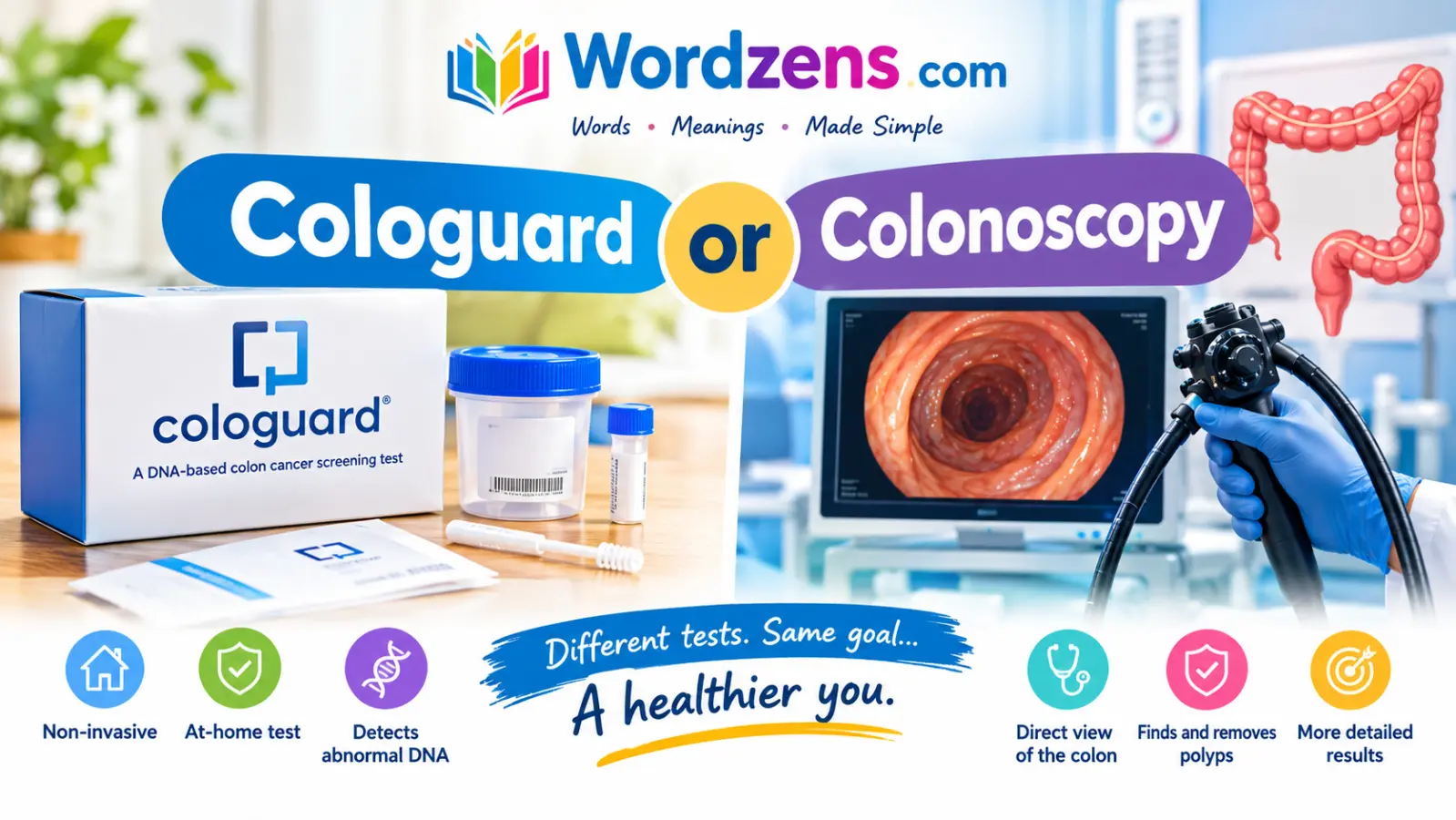
Picture this. Your doctor tells you it’s time for colon cancer screening. Before you can even process that, they throw out two words that sound like they belong in the same sentence. Cologuard and colonoscopy. Your brain short circuits a little, right?
You’re not alone. These two terms get mixed up all the time. They both start with “colo” and they both aim at the same goal. Catching colon cancer early. People often assume the two are interchangeable, or even that one is just a nickname for the other.
Although they look and sound similar, they serve completely different purposes. One is a mail in stool test you can do from your bathroom. The other is a hands on medical procedure performed by a doctor. Mixing them up isn’t just a small mistake. It could shape a real health decision. So let’s clear this up in plain, simple English.
What Is “Cologuard”?
Cologuard is the brand name for an at home stool DNA test used to screen for colorectal cancer and precancerous polyps. It was the first at home stool test of its kind approved by the U.S. Food and Drug Administration back in 2014. It’s made by a company called Exact Sciences.
Here’s how it works. Your doctor orders the kit. It arrives at your house. You collect a small stool sample in a container. That sample gets shipped to a lab, where technicians check for DNA markers and traces of blood that can signal cancer or precancerous growths. No fasting. No sedation. No time off work.
Cologuard is mainly used in the United States, since it’s tied to FDA approval and U.S. insurance rules including Medicare. It’s typically recommended for average risk adults aged 45 and older, repeated roughly every three years.
Example sentences:
My doctor suggested I try Cologuard since I don’t have a family history of colon cancer.
The Cologuard kit showed up in a plain box and I mailed it back within a week.
A quick usage note. People sometimes use “Cologuard” as if it’s a generic term for any stool based screening test. It’s actually a specific trademarked product, not a catch all category.
What Is “Colonoscopy”?
A colonoscopy is a medical procedure, not a test kit. During a colonoscopy, a doctor usually a gastroenterologist uses a long flexible tube with a tiny camera on the end to examine the colon and rectum. It’s used to look for polyps, inflammation and cancer. Importantly, the doctor can often remove polyps on the spot during the same visit.
The word itself comes from Greek roots. “Colon” for large intestine plus “oscopy” for looking at something. It’s a general medical term, not a brand name, and it’s used worldwide in the US, the UK and beyond. Screening guidelines and starting ages can vary slightly by country.
Example sentences:
The gastroenterologist recommended a colonoscopy because polyps run in my family.
I had to follow a strict prep diet the night before my colonoscopy.
Spelling and regional notes. “Colonoscopy” is spelled the same way in American and British English. No tricky regional variant here. It’s typically done under sedation, requires bowel prep the day before and is usually repeated every 10 years if results come back normal for an average risk patient.
Key Differences Between Cologuard and Colonoscopy
Both aim to catch colorectal cancer early. That’s really where the similarity ends. Here’s a breakdown.
Format. Cologuard is a mail in stool sample kit. Colonoscopy is an in person medical procedure.
Prep required. Cologuard needs no prep or sedation. Colonoscopy requires bowel cleansing prep and usually sedation.
What it can do. Colonoscopy can find and remove polyps in one visit. Cologuard can only flag a possible problem.
Follow up. A positive Cologuard result always needs a follow up colonoscopy to confirm.
Frequency. Cologuard is typically repeated every 3 years. Colonoscopy every 10 years if normal.
Cost. Cologuard generally costs less out of pocket than colonoscopy, though both are often covered by insurance for eligible adults.
Comfort. Cologuard is done privately at home. Colonoscopy involves a clinical setting and downtime for recovery from sedation.
Comparison Table
| Feature | Cologuard | Colonoscopy |
|---|---|---|
| Type | At home stool DNA test | In person medical procedure |
| Sedation needed | No | Usually yes |
| Bowel prep | No | Yes |
| Can remove polyps | No | Yes |
| Typical frequency | Every 3 years | Every 10 years if normal |
| Follow up if positive | Colonoscopy required | Treatment decided immediately |
| Where performed | At home | Clinic or hospital |
| Approved for | Average risk adults 45+ | Average and higher risk adults |
Real Life Conversation Examples
Dialogue 1 Amy: I just scheduled my Cologuard for next month. Ben: Oh is that where they put the camera inside you? Amy: No that’s a colonoscopy. Cologuard is the mail in stool test.
🎯 Lesson: Cologuard involves no camera or procedure. It’s a lab test done from a sample you send in.
Dialogue 2 Priya: My aunt had a colonoscopy last week and said the worst part was the prep. Sam: I thought that was the DNA test thing? Priya: Nope that’s Cologuard. This one’s the actual scope procedure.
🎯 Lesson: The uncomfortable prep step belongs to colonoscopy not Cologuard.
Dialogue 3 Doctor: Your Cologuard test came back positive. Patient: So I have cancer? Doctor: Not necessarily. We do need a colonoscopy to know for sure.
🎯 Lesson: A positive Cologuard result isn’t a diagnosis. It always leads to a colonoscopy for confirmation.
Dialogue 4 Maria: Which one removes polyps if they find any? Jake: I think it’s Cologuard. Maria: Actually only a colonoscopy can remove polyps during the exam itself.
🎯 Lesson: Only colonoscopy allows a doctor to remove polyps in the same session.
Dialogue 5 Grandpa: Back in my day we just had “the scope.” Grandson: Now there’s a version you can do at home called Cologuard. Grandpa: So no doctor’s office at all? Grandson: Right. Just a kit a sample and the mail.
🎯 Lesson: Cologuard offers a modern at home alternative to the traditional in office colonoscopy.
When to Use Cologuard vs Colonoscopy
Neither test is universally better. The right choice depends on your personal risk level and preferences, and it’s a decision to make with your doctor. That said here are some general patterns.
Choose Cologuard when you’re at average risk, have no family history of colorectal cancer or polyps, want to avoid sedation and prep and prefer testing privately at home.
Choose colonoscopy when you have a family history of colon cancer or polyps, previous abnormal results, symptoms like unexplained bleeding, or you want the most thorough single test that can treat problems on the spot.
Memory trick. Cologuard is the container you mail. Colonoscopy is the camera on a cord.
US vs UK usage. Cologuard is essentially a US specific product tied to FDA approval and US insurance systems. In the UK and many other countries, stool based screening usually relies on a different test called FIT, the fecal immunochemical test. “Colonoscopy” is used internationally with the same spelling and meaning.
Always talk to your doctor about your personal risk factors before deciding. This article is meant to explain the difference between the two terms, not to replace medical advice.
Fun Facts or History
Colonoscopy techniques trace back to the 1960s, when flexible fiber optic scopes first let doctors see deep into the colon without surgery. That was a huge leap from earlier rigid instruments.
Cologuard’s core innovation is detecting altered DNA shed by abnormal cells in the stool, not just blood. That’s what sets it apart from older simpler stool tests like FIT.
FAQs:
Is Cologuard as accurate as a colonoscopy?
Cologuard is highly sensitive for detecting cancer itself, but it’s less reliable than colonoscopy at spotting smaller precancerous polyps, and it can produce false positives.
Does insurance cover both tests?
In the US both are commonly covered for eligible average risk adults aged 45 and older. Coverage details vary by plan so it’s worth checking with your insurer.
What happens if my Cologuard test is positive?
A positive result means abnormalities were detected in the sample. It doesn’t mean you have cancer. Your doctor will recommend a follow up colonoscopy to investigate further.
Can I skip colonoscopy entirely if I use Cologuard?
Only if your Cologuard results stay negative. A positive result always calls for a colonoscopy to confirm what’s going on.
How often do I need each test?
Cologuard is generally repeated every 3 years for average risk adults. Colonoscopy is usually repeated every 10 years if the result is normal.
Conclusion:
At the end of the day Cologuard and colonoscopy are two very different tools built for the same overall goal. Catching colon cancer early, when it’s most treatable. Cologuard is a convenient no prep stool test you complete at home.
Colonoscopy is a hands on procedure that can both detect and remove problems in a single visit. Neither one automatically wins. The right pick depends on your risk level, your comfort and what your doctor recommends.
Understanding these differences helps you make an informed choice rather than just picking a name that sounds familiar.
Next time someone uses these two words, you’ll know exactly what they mean!

I’m Peter Jones, the founder of Wordzens.com. I’m passionate about creating clear language guides, word meanings, grammar resources, and educational content that helps readers expand their vocabulary, improve their communication, and learn with confidence. My goal is to publish high-quality, easy-to-understand content that makes learning words and language skills simple, useful, and enjoyable for readers of all levels.